


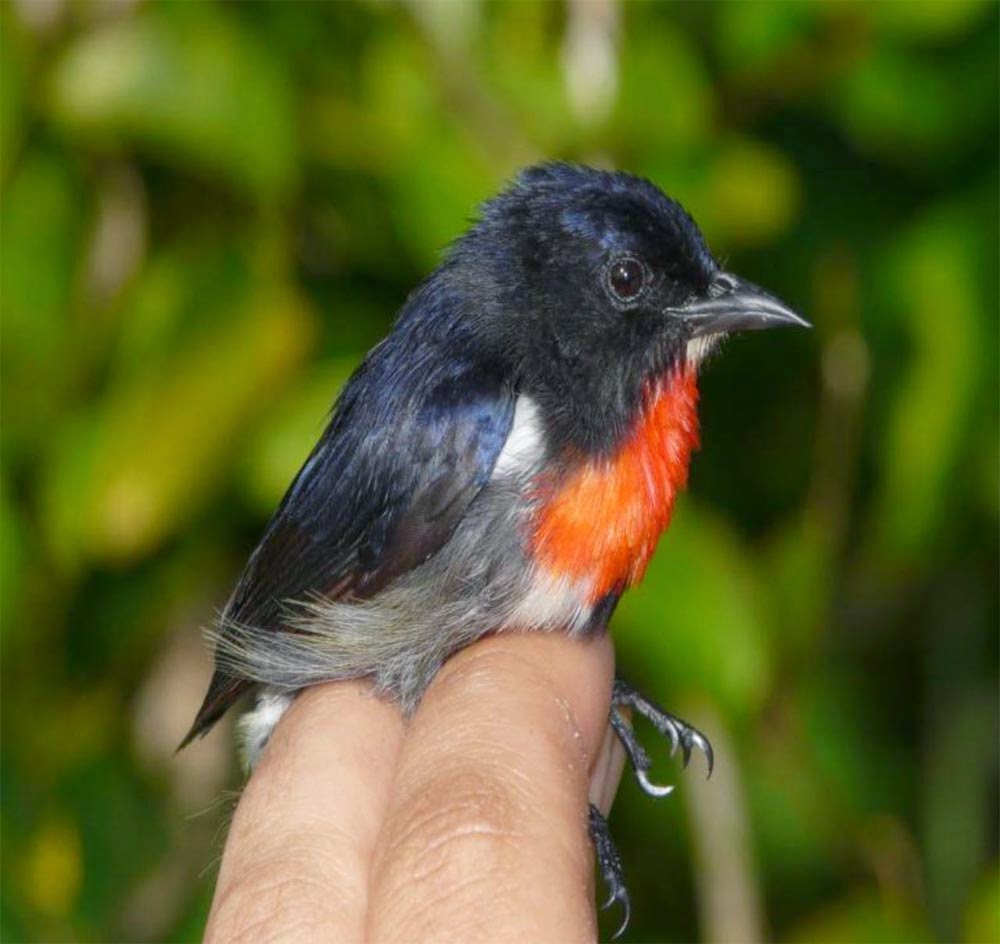
Dicaeum flowerpeckers are small (10 to 18 cm long), often colorful birds.
Ding Li Yong, a PhD student at the Fenner School of Environment and Society at the Australian National University (ANU), helped to confirm the new species, known as the Sulawesi Streaked Flycatcher.
"The locals knew we were there for a biological expedition and so a hunter came to us with some dead birds," Yong said on Tuesday. "We obtained these specimens and one was this new species."
"We instantly knew that it couldn't be anything else."
Dicaeum flowerpeckers have short tails, short thick curved bills and tubular tongues.
During the months of July, August and September in various years between 1999 and 2012, Dr Nicola Marples of Trinity College and his colleagues sampled individuals of a previously recognized Dicaeum species – the Grey-sided flowerpecker (Dicaeum celebicum) – from seven sites across the Wakatobi archipelago, Buton Island and the south-eastern peninsula of Sulawesi. In total, 58 flowerpeckers were mist-netted and studied.
The combined results from genetic, phylogenetic and morphological analyses indicated that flowerpeckers from a small chain of islands known as the Wakatobi Islands are a new species, named the Wakatobi flowerpecker (Dicaeum kuehni).
The genetic data also revealed that the Grey-sided flowerpecker and the Wakatobi flowerpecker did not mix or interbreed, which in turn suggests that they do not cross the 27 km stretch of ocean between them.
Posted in:
Dicaerum Flowerpecker,
Science,
Top News,
Wakatobi Flowerpecker
| Monday, November 24, 2014

"Regin displays a degree of technical competence rarely seen," Symantec said in a statement Sunday, released along with a technical white paper about the malware. Indications are that Regin "is one of the main cyberespionage tools used by a nation state."
Researchers have identified its use in 10 countries, mainly Russia and Saudi Arabia, as well as Mexico, Ireland, India, Afghanistan, Iran, Belgium, Austria and Pakistan.
Regin is a back-door-type Trojan, "customizable with an extensive range of capabilities depending on the target," Symantec said, adding that "it provides its controllers with a powerful framework for mass surveillance." Its development probably took months "if not years" and "its authors have gone to great lengths to cover its tracks."
Its first incarnation was used to spy on a number of organizations from 2008 to 2011 when it was "abruptly withdrawn," with a new version showing up last year, Symantec said.
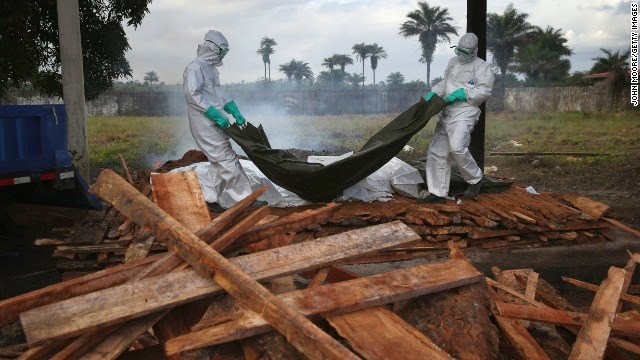
The government said in a statement Saturday that the patient who tested positive for Ebola has been quarantined and is receiving intensive treatment.
Mali is monitoring more than 300 people who had contact with Ebola patients, in an effort to limit the spread of the virus. Seven Ebola cases have been confirmed in the West African nation, and all of those patients, except the most recent case, have died.
On Friday, the WHO said the death toll in the Ebola epidemic had risen to 5,459 out of more than 15,000 cases. The cases are in eight countries, with the majority in three West African nations - Guinea, Liberia and Sierra Leone.
U.N. chief Ban Ki-moon said Friday there has been some progress in battling the Ebola outbreak, but warned the fight is far from over.
Ban said new cases appear to be slowing in some areas where officials and health care workers have implemented what he called a "strong response strategy." However, he said cases are increasing in other regions.
Ban said the new chain of transmissions in Mali is a "cause of deep concern."
While Mali has been saying some 300 people are being monitored for Ebola exposure, the WHO puts the total at nearly 500.
Alibaba Group Holding Ltd. has becomes a new favorite customer in Wall Street [BABA +0.83%]
Yorker News - The Chinese e-commerce company has emerged as this year’s biggest source of fees for banks working on capital-markets deals. After its $25 billion initial public offering in September, the largest in history, the Chinese Internet company on Thursday sold $8 billion in bonds, one of the largest corporate-bond deals of the year.
While fees weren’t disclosed, the banks coordinating the sale—led by Morgan Stanley, MS +0.40% with assistance from Citigroup Inc., C +0.26% Deutsche Bank AG DB +2.05% , J.P. Morgan Chase JPM +0.55% & Co. and seven others—reaped millions of dollars for their efforts in finding buyers for the bonds.
Morgan Stanley and the other banks coordinating the sale are lenders to Alibaba under an $8 billion credit facility that has already been used. Alibaba plans to use proceeds from the bond sale to help pay off that $8 billion loan, which carries variable interest rates tied to the overall market. The bonds sold Thursday mostly carry fixed rates, potentially giving the company savings over time should market rates rise.
When drugstore chain Walgreen Co. WAG +0.37% completed an $8 billion bond sale this month, banks on the deal reaped nearly $40 million, according to a securities filing.
Banks have collected more than $35 billion in fees so far this year on new stock and bond offerings, according to data provider Dealogic, up from about $32 billion at this time last year. Alibaba is already the largest payer of underwriting fees to banks this year, dispensing $291 million to the arrangers of its September IPO, according to Dealogic.
Alibaba has eclipsed firms such as Canadian energy company Encana Corp. ECA +2.20% , French telecommunications firm Numericable NUM.FR +4.16% Group SA and Japanese real-estate company Mitsui Fudosan Co. 8801.TO +0.48% to top the rankings of the most lucrative underwriting clients globally this year, according to Dealogic figures.
The underwriting boom alone won’t fill in the gaps for banks under pressure amid soft trading and low interest rates. Underwriting fees are just a fraction of the revenue generated by securities sales and trading, for example.
In an unusual move, Alibaba insisted that there be no lead bank on its initial share offering. The company listed five banks on the deal in alphabetical order— Credit Suisse Group AG CS +0.80% , Deutsche Bank AG, Goldman Sachs Group Inc., GS -0.08% J.P. Morgan and Morgan Stanley—to reflect their equal base fees for the deal, with a sixth lead bank, Citigroup, listed after them because it received a smaller base fee, people familiar with the deal have said.
Alibaba intended the arrangement to reward each of the banks for prior work with the company and to maintain future relationships, though some bankers were frustrated that the initial pay didn’t reflect different roles in the deal, the people said.
The $291 million IPO fee reflected a pay rate of 1.2%, which was slightly more than the 1.1% Facebook Inc. FB +0.20% paid in its $16 billion IPO, completed in 2012. It was still far less than the typical 6% to 7% awarded in most IPOs.
Morgan Stanley began discussing the bond sale with Alibaba as many as 18 months before the IPO, people familiar with the deal said. The company chose to sell the bonds this week in part because investors had a chance to review Alibaba’s first quarterly earnings as a publicly traded company. Market conditions were good and the Thanksgiving holiday—when bond markets are closed—is coming up, the people said.
Investors said demand for the Chinese company’s debt was robust, underscoring the hefty appetite for income-generating investments at a time of uneven global growth and low interest rates. Alibaba received as much as $55 billion in orders for the debt, said people familiar with the deal, joining other technology companies such as Apple Inc., AAPL +0.14% Oracle Corp. ORCL +1.27% and Cisco Systems Inc. CSCO +0.26% in completing multibillion-dollar bond sales in 2014.
Strong demand sent yields lower. A five-year bond, for example, was initially offered to yield about 1.10 percentage points more than comparable Treasurys earlier in the week, but that figure fell to 0.95 percentage point on Thursday, for a yield of 2.582%. In total, Alibaba’s deal came in six parts, with maturities ranging from three to 20 years.
"We recognize that the way people here in the United States and around the world access and consume information has changed dramatically over the past decade," said Shawn Turner, a White House deputy press secretary. "That's why, in addition to traditional media formats, we use a wide range of new and emerging communication vehicles including social media, websites and podcasts to reach audiences."
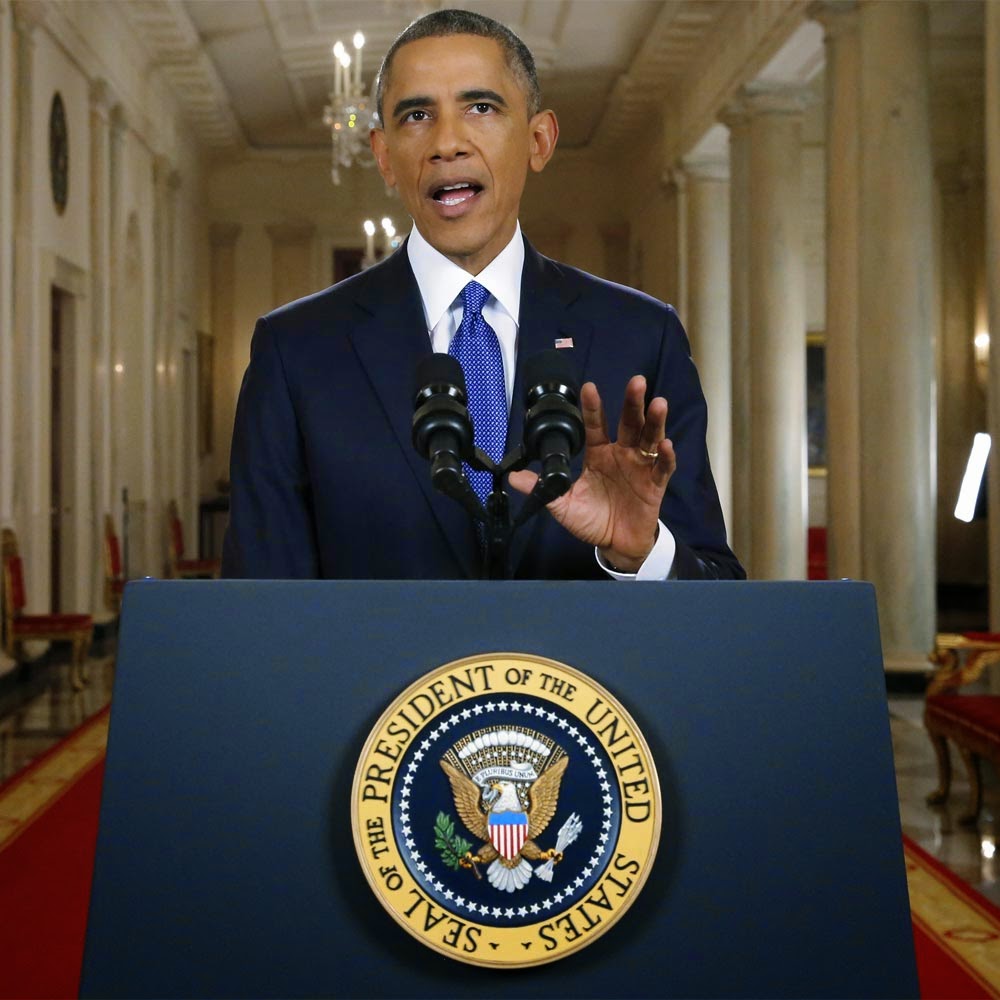
Yorker News - At least 14.6 million people watched President Obama's prime-time Thursday immigration speech live, a figure that put it neck-and-neck with CBS's The Big Bang Theory in the same time slot.
But Obama's audience was a also fraction of the 41.6 million viewers President George W. Bush commanded for a similar White House address to the nation in 2006.
The big difference? The three major broadcast networks carried Bush's speech live. Obama was largely relegated to basic cable. But the White House also notes they had an advantage Bush did not: Social media.
Nielsen Media has not put out a combined audience number for Obama's speech. But adding together numbers released by the major networks puts Obama on par with The Big Bang Theory's 14.6 million viewers.
Univision, a Spanish-language network, won the night, commanding 4.8 million viewers. But many of them may have tuned in for the scheduled Latin Grammy Awards, which were delayed 15 minutes by Obama's speech. Telemundo delivered another 2 million, providing what that network said was its best-performing news night of the year.
English-language Fox News Channel, citing Nielsen figures, reported nearly 4.3 million viewers, followed by MSNBC with 1.8 million, and CNN with 1.7 million.
Obama's ratings do not include those who may have watched on PBS or C-SPAN, or on any number of local affiliates who preempted network programming.
It also does not include online viewership. The White House says nearly 300,000 people watched the speech on its website (though not all live). Four Facebook videos — including a preview, a behind-the-scenes movie and two clips from the speech — got a combined 7.5 million views.
